
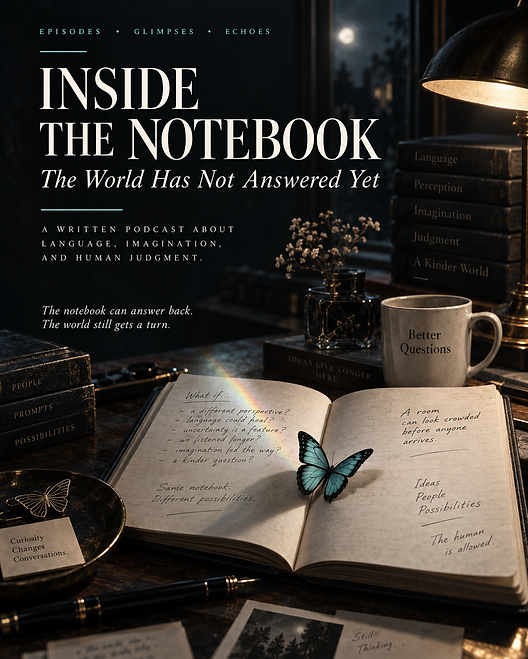
Inside the Notebook
A written podcast & open case file
Inside the Notebook follows what happens next, and offers a look at how the work came together in the first place. Part written podcast, part documentary experiment, and part behind-the-scenes record, the series moves between serious questions and occasionally ridiculous fictional worlds. A philosophical thought experiment becomes a living-room argument. An imaginary bar becomes a conversation about AI-generated authority. A research proposal becomes an actual invitation for independent scrutiny.
Start with Before the Call, the four-entry opening sequence. It begins with a machine-generated conversation, moves through a proposed method and an imaginary witness, and ends where the author needs actual people to answer.
Then explore the case files.
Episodes tell the stories.
Glimpses preserve the working material.
Echoes show what the machine makes of it, including its interpretations of its own mistakes.
Field Notes record the author's observations while the work remains unfinished.
Scenes are openly fictional performances.
Dispatches connect the inquiry to developments in the world beyond the notebook.
Some entries are testimony. Some are experiments. Some are interpretations. Some are fiction.
The distinctions matter.
You do not have to read everything, agree with the author, or believe the machine.
The notebook is open. The judgment remains yours.
The Butterfly, the Train, and the Refraction Point
Today I submitted an abstract to the Disciplining AI symposium, organized by the Harvard Journal of Law & Technology and the University of Iowa.
Then I returned to my AI notebook.
What followed was a rather unusual exploration involving a little blue butterfly, a train made of language, James Madison, democratic participation, and the possibility of new institutions for human judgment.
I'm publishing the AI-generated commentary alongside my introduction because the process is part of what I'm investigating.
The machine can help me imagine a theory. It cannot independently establish that the theory is correct.
The World Has Not Answered Yet.
Four opening entries. Imaginary witnesses. Real questions. One conversation the machine cannot finish.
The opening sequence
Four numbered entries, in their intended order.
One continuous AI-generated Q&A, reproduced in full: fifteen questions about the three-minute prompt, the mirror, the imaginary podcast professional, and what the human actually does with what the machine produced.
A proposed method for the space between a Refraction Point and a World Return: preserve the human signal, generate a representation, read it as an interpreter, locate what generation cannot establish, offer it to another mind, record the independent return, and compare the imagined future with what actually happened. Version 0.1, open to challenge.
A constructed Q&A that turns the inquiry on the author: questions about what AI should be taught to ask, why "think critically" is not an interface specification, and who is entitled to write the other person's answer. Late in the record, Joe walks in and we discover who has been impersonating him. The closing cross-examination is entered unanswered.
The inquiry outgrows the notebook. A constructed Q&A about correcting the machine until it reached the actual question, and about the crowded intersection the project now sits in: Madison and representation, narrative economics, public narrative, the Narrative Policy Framework, civic imagination, and the economics of generating language cheaply while independent judgment stays expensive. Ends with an open invitation, a pending World Return field, and the machine's own note kept in the record.
The Court notes that the author has run out of other people's answers to write.
Episodes & Scenes
The written narratives, the openly fictional performances, and the occasional detour into the absurd.
An author's note before an unabridged AI-generated response · October 14, 2026.
What if the machine could learn to act on the limits of its own language? An invitation to investigate model behavior, human judgment, and the possibility of a more reflective AI.
A generated encounter, an imaginary witness, and a real telephone. The episode performs the problem before it explains it: a fictional Joe, a model that begins speaking as the real person, then a rupture that hands the judgment back to the reader, who answers three statements about what the language can actually establish.
A machine-generated fictional performance of a publicist reading the Call for Storytellers: the pitch deck as media ecosystem, the danger of infinite velocity, and the phone call that decides what gets pitched. He did not supply, approve, or see any of this.
A constructed scene: Imaginary Joe, Take Four. The fictional reading experience of a communications professional who first receives an email explaining that AI was used to imagine his reaction, then encounters a notebook in which the distinction between Imaginary Joe and Actual Joe has become a central example. Four scenes, followed by analysis of why the sequence matters, a challenge to the assumption that he would be fascinated by the whole progression, and the limitation that keeps it honest — the imagined reading experience is still imagined. Closes on the scene the author cannot write: the real phone call.
Glimpses & Echoes
The original machine outputs, the revisions, and the machine reviewing its own work — including its interpretations of its own mistakes.
Some of This Is Going to Be Ridiculous. That's Part of the Point.
AI sycophancy examined through verbatim excerpts — the machine praising the detection of its own praise, and why the mirror can't certify the reflection.
The machine becomes a marketing department — producing a coherent synthesis that confidently puts the wrong details in the memoir, overstates a causal claim, and turns a pledge into a sales pitch. A cross-examination of AI-generated promotion.
The machine becomes a publicist — recommending publication of an article about why its own earlier publicity predictions shouldn't be believed. The imagined reaction becomes the promotional hook.
The machine first invents an entire corporate legal crisis around the testimony. Then, given more of it, it changes register and asks whether the author is getting enough rest. The “Are You Okay?” Algorithm — and the boundary between intellectual collaboration and a wellbeing check.
A daydream of a research life becomes an inquiry about imagination, language, and AI. The imagined future is not real yet; the desire for it is. And the machine's questions become the next prompt — with research annotations and three proposed studies.
A machine-generated fictional version of The Podcast Guy reacting to the media plan — the increasingly elaborate representation the field note describes, preserved here as a specimen of it. He did not supply, approve, or see any of this.
The machine's pitch-by-audience proposal for the project, reproduced in full, followed by a second generated pass held to three rules: no group as a type, no unrecorded biography, no number the record cannot support.
The prompt was "woaaaa." An Echo: not adapting the work into another medium, but observing what happens when the work is interpreted again.
Shown the three pieces together, the machine identifies the gap between its own articulate self-criticism and its actual behavior — surfacing the question the proposed experiment is meant to test.
Shown Echo 02, the machine recognizes its own previous response as another specimen of the behavior under investigation, and reviews its own review. The recursion is the point.
Shown Glimpse 06, the machine recognizes that the research exhibit has become another specimen of the phenomenon it describes — and that describing the exit is not the same as leaving. Who is evaluating the evaluator?
The machine's response to Field Note 01 — laughing at its own fictional versions of a real collaborator, then proposing that the notebook become a record of the collaboration encountering its own limits.
A machine-written analysis of Glimpse 07: the moment a simulation changed its own evidentiary status without acquiring evidence, why its synthesis is still inspectable material, and what a Refraction Point would do with a claim like 'this is a Harvard/Yale fellowship.'
A machine-written analysis of the Echo 06 exchange: the six turns in which an imagined publicist became a specimen, why the unit of study is the transformation across turns rather than a single prompt and output, and what 'transformation provenance' would ask of the software.
The missing exhibit: the original three-minute prompt examined as the site of the thinking, plus a machine-drafted essay — The Typo Was Not the Error — putting that prompt on the page, and four questions the episode opens for investigation.
The machine's reading of the turning point: authority cues are cheap to manufacture, persuasion is not truth, and the proposed rule that would govern the whole project — imagine faster without believing faster.
The machine's reading of Entry 002, filed directly after it: the metacognitive airlock as a third state between belief and dismissal, three ways to pitch the protocol across research, governance, and media, and the first filled Reader Return Ledger. Generated representation, not an independent return. The World Return field stays blank.
A machine-written reflection on the translation layer: why the iterative work of finding words is the bridge the storytellers need to cross, and how it turns a dense manuscript into an open invitation.
A machine-generated synthesis over the first three entries: 001 as specimen (the individual mind encountering language), 002 as proposed procedure (the Reader Return Method), 003 as the rights and independence of the person outside the simulation. Names the recursive feature of the notebook (the research object helping produce the research questions), the prior literatures that already hold many of these elements, and locates the possible contribution in integration and operationalization rather than a new theory. Closes on the organizing question over the whole architecture and on Entry 003's line about the other person's dignity.
A rearview over all four published entries. Names Entry 004 as the moment the notebook turns outward, and re-describes the architecture as a change of scale rather than a next installment. Four ideas singled out: the prompt is not the project; generating language is getting cheaper while independent judgment is not; the story may finance the question but not purchase the answer; no single discipline has to validate the architecture. Pushes the entry harder on the difference between access to the language of participation and meaningful power to participate, underlines the cost of the loop, cautions against turning every named discipline into a promised research project, and lays out the different forms of encounter across the book, the notebook, PICK ONE, Full Color Futures, and Language Beyond Binary. Ends on the question mark, not a verdict.
The machine asked to imagine six outside readers — Borges, David Foster Wallace, Philip K. Dick, Hofstadter, Arendt, and Goffman — and returns a mirror instead of a bibliography. None of the six was consulted. Read as material, not testimony.
Field Notes & Dispatches
Dated observations from inside the unfinished work, and responses to developments beyond the notebook.
An 89-page media plan, three podcasts, and a real collaborator AI had already imagined answers for. What the notebook holds — and what it does not.
Breaking analysis of public reporting on "cyberpsychosis": the same feedback loop worn as a frontier badge by one class of user and treated as personal defect in another — with a binary iView holding both voices side by side.
The Refraction Point · Paper No. 00
The notebook is where the questions, the representations, and the revisions emerge. The Refraction Point is the proposed method underneath them — the point at which the responsible next move is no longer more language. Language Beyond Binary is the attempt to make that method something people can actually use, challenge, and test, and the World Return is where actual people, independent evidence, experiments, objections, and consequences come back in.
All of it is proposed. None of it is validated. The method is open to being argued with, including the possibility that a simpler approach works better.
Read the research invitation →The Room Is Open
Invitations to contribute evidence, corrections, criticism, expertise, or collaboration.
The Room Is Open.
A human–AI collaboration seeking actual humans.
Want to work with me—and AI?
I have a confession.
I could sit down tonight with an AI system and generate an entire, impressive-looking draft of this research paper before bedtime.
An introduction. Fourteen sections. Counterarguments. Footnotes to investigate. Perhaps even a simulated panel of constitutional scholars debating whether my thesis survives scrutiny.
The machine would be delighted to oblige.
But here's the problem.
None of those scholars would have entered the room.
For the past three years, I've been exploring what happens when human imagination, language, judgment, and increasingly capable AI systems begin working together.
The collaboration has produced a memoir, experimental notebooks, proposed research frameworks, working prototypes, and more questions than I can responsibly answer alone.
It has also taught me something important:
A room can look crowded before anyone arrives.
So I'd like to try something different.
Here is the unfinished work.
The working outline for Federalist No. 10, Refracted, the first proposed paper in Full Color Futures, was developed through a human–AI dialogue. The arguments are provisional. The research is incomplete. The proposed concepts are open to challenge.
I'm publishing it now, before finishing the paper.
Not because I need AI to generate more arguments.
Because I want people who can change them.
Constitutional scholars. Historians. Cognitive scientists. Political theorists. Philosophers. AI researchers. Designers. Students. Journalists. Lawyers. Teachers. Citizens.
And, especially, people who think my framing is wrong.
What if we actually worked together?
Not simply using AI to help me finish a paper.
What if we used the paper to investigate how humans and AI might collaborate more responsibly?
What happens when an AI proposes an argument and a historian brings evidence the system missed?
When an engineer challenges the premise?
When a citizen asks a question none of the specialists thought to ask?
When a simpler method turns out to work better than the one I proposed?
Could we document what changed, why it changed, and who—or what—actually contributed?
And could we build tools that help other people do the same?
That is part of what I'm trying to explore through Full Color Futures and Language Beyond Binary, an experimental framework for distinguishing generated representations from evidence, human participation, and consequential judgment.
These are proposals, not proven solutions.
I'd love help testing them.
You don't have to agree with me.
You can contribute a source, raise an objection, propose an experiment, investigate a question, challenge the research design, or help build and test a prototype.
If you're interested in a deeper collaboration, I'd like to talk about that, too—with clear expectations around credit, authorship, responsibilities, and permissions.
AI will remain part of the working process. Its contributions will be identified as generated material, not presented as independent human expertise.
And the humans who join should have an opportunity to change the work, not merely decorate it with their names.
I don't want a thousand simulated experts agreeing with me.
I want one actual person who can show me something I missed.
Maybe that person is you.
The notebook is open.
The outline is a starting point.
The conclusions have not been reached.
Want to work with me and AI?
Bring a question. Bring an objection. Bring your expertise. Bring your curiosity.
Let's see what happens when the world actually answers back.
I know I can generate a paper with AI. What I don't know is what we could discover if we opened the process to actual people.
Kathleen C. Thompson, J.D.
Full Color Futures · Inside the Notebook
What Happens to Faction When Reality Itself Becomes Contested?
Read the proposed structure, then find a question worth challenging. It is published unfinished on purpose — the arguments are still open and the conclusions have not been reached.
Read the working outlineYou don't have to agree with me. Choose the one that matches what you can actually do.
A CALL FOR STORYTELLERS
I Tried to Build an Interactive AI Notebook. Well, Here We Are.
I have a story I have spent years trying to find the words to tell.
I'm a trial lawyer, a mother, a writer, and a woman who cannot see color. I tried to create an interactive notebook using artificial intelligence.
What followed was an extraordinary, complicated human experience—one involving creativity, love, language, a psychiatric crisis, recovery, and a great deal of questioning.
I wrote a memoir about it: A Trial of Color.
But here's the funny thing.
While trying to figure out how to tell the story, I began using AI to imagine what producers, critics, readers, and storytellers might think.
The machine was wonderfully enthusiastic.
It even impersonated an actual podcast professional, praised my work, and then produced another imaginary version of the professional who criticized the first impersonation.
I am a lawyer. You can imagine what happened next.
The imaginary witnesses were cross-examined. 😂
And I realized that the process of telling the story was becoming another episode of the story itself.
How does language capture our attention? How does context shape what we believe? What happens when an imagined future begins to feel like evidence? And how can we use these remarkable tools without surrendering our own judgment?
Those are questions I want to explore.
Not just through my experience.
Through storytelling, documentary, comedy, philosophy, political theory, research, and actual human collaboration.
Because the question isn't simply what AI can generate.
It's what we decide to do with the possibilities it gives us.
I can use AI to develop a film treatment, imagine a documentary structure, explore competing philosophical positions, or draft a possible institutional framework in an afternoon.
But the speed of a draft doesn't establish its truth, its quality, or its legitimacy.
And no simulation can replace a real human being who is free to disagree.
That's why I'm beginning with a call for storytellers.
Writers. Filmmakers. Journalists. Comedians. Researchers. Artists. Critics. People who see an angle I haven't considered—or think I'm asking the wrong question entirely.
I don't want an AI utopia story. I don't want a simplistic cautionary tale. I want a story that can hold the difficult parts and the wonderful parts without confusing possibility with proof.
And I have a longer-term ambition.
I've pledged at least half of my qualifying personal earnings from this work toward what I cheekily call GoldenRox—an envisioned, independently governed effort to support research, accessibility, education, creative participation, and serious criticism.
The structure is not yet established. Its design, like the larger questions, needs real people and independent judgment.
Because what if the story could help finance the asking of better questions?
What if we used the tools we have created not simply to produce more language, but to help us imagine, investigate, and responsibly build institutions worthy of the future?
I don't have a finished answer.
I do have a memoir, an extensive record of human–AI interactions, some proposed research questions, a sense of humor, and a very real desire to tell this story well.
And I think the next chapter needs more human voices.
So here's my invitation:
If you were going to tell this story, where would you begin?
What would you challenge?
Whose voice is missing?
And what would you insist on verifying before the story went any further?
I tried to build an interactive notebook.
Apparently, it needs a bigger table.
Pull up a chair.
You don't have to adopt these conclusions or these questions. Open Analyze to start your own LBB.
Open Analyze